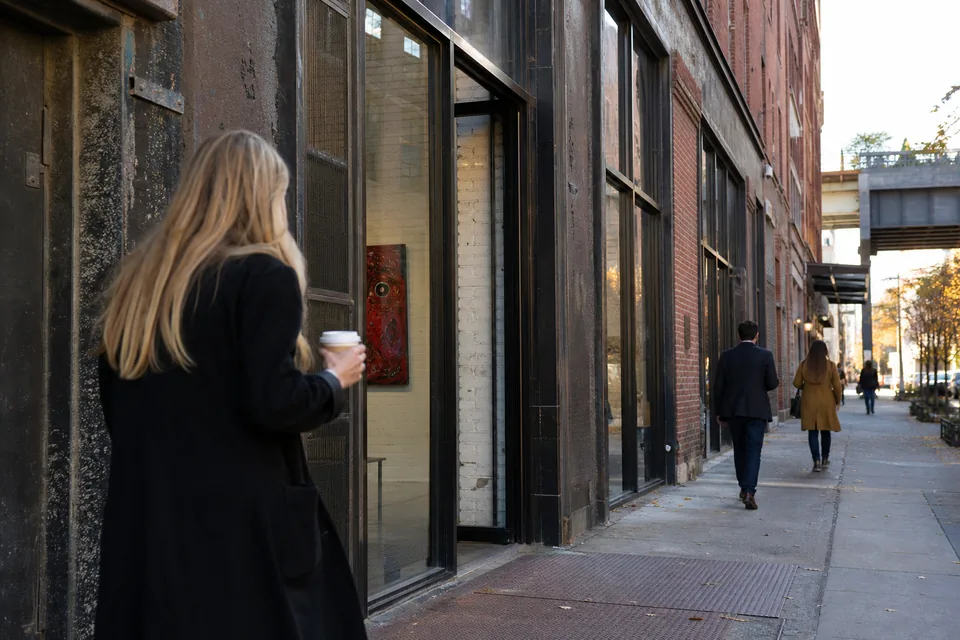
Where Tribeca galleries cluster
The center of the district is the area around Walker, White and Franklin Streets, with galleries also spread along the nearby blocks of Broadway, Church Street and Lispenard Street. The streets are short, and you can see a lot in a small area.
- Many galleries occupy upper floors of cast iron and loft buildings. Look for small signs and buzzers by the street door.
- Several buildings hold more than one gallery, so check the lobby or the doorbell panel.
- Ground floor spaces are fewer and often smaller than in Chelsea, which gives many shows an intimate feel.
For an overview of all districts, see our art galleries nyc guide.
What kind of galleries you find in Tribeca
Tribeca mixes galleries that moved from other neighborhoods, newer galleries that opened here first, and outposts of galleries based in other cities. Programs range from emerging artists to established names, and the overall tone sits between the experimental Lower East Side and the large spaces of Chelsea.
- Expect painting, sculpture, works on paper and photography in rooms scaled for domestic size work.
- Directors are often easy to reach, and conversations tend to be relaxed.
- Exhibitions change through the season, so a return visit a few weeks later usually means new work.
Planning your Tribeca visit
Two to three hours is enough to see most galleries in the district at a comfortable pace. Make a short list, then walk the streets in a loop between Canal Street and Franklin Street.
- Tribeca galleries tend to open Tuesday to Saturday, and a few add Sunday afternoons.
- Summer hours are often shorter and August is quiet.
- Tribeca pairs well with the Lower East Side in one day. Read the lower east side galleries guide to plan the second half.
- If you prefer large spaces and many galleries in a row, save Chelsea for its own afternoon with the chelsea art galleries guide.
Openings in Tribeca
Tribeca openings are evening receptions, usually on weekday evenings, and when several galleries open on the same night it is easy to walk between them. They are generally open to the public. Upper floor spaces fill up quickly, so expect lines at the elevator or stair on busy nights. For a calm look at the work and a real conversation, return on a weekday afternoon. Our art exhibitions nyc guide explains how to keep track of new shows.
Asking about prices and holds
As elsewhere in New York, prices are rarely on the wall. Ask for the checklist, which lists titles, media, dimensions and prices.
- Ask about a work by title and note its size and medium.
- Tribeca rooms are small and staff are close at hand, so asking for a short hold is easy. A hold here usually lasts a few days at most, and it is always the gallery's choice.
- When a work is reserved or sold, ask about related work in storage or future availability.
- Confirm what the price includes. Sales tax, shipping and installation are usually separate lines on the invoice.
Read what buying from a gallery involves for the invoice and delivery steps after a Tribeca purchase.
Seeing more than what is on the walls
The exhibition is only part of what a gallery can show you. Most galleries keep other works by their artists in storage or a back room, and many prepare PDFs of available works or private online viewing rooms for collectors who ask.
- If you like an artist, ask whether there are other works available beyond the current show.
- Ask for images with dimensions and prices sent by email, so you can compare later at home.
- If you are considering a large work, ask for a photo of it in a room or the exact dimensions in inches and centimeters to check against your wall.
- If you are new to the gallery, it is natural to mention what you already collect. It helps the director suggest relevant work.
Getting to Tribeca and getting around
Canal Street and Franklin Street stations are a short walk from the gallery streets, and the neighborhood is pleasant on foot. Taxis are easy to find on Broadway and the avenues. The Lower East Side is to the northeast and SoHo is directly north, so it is simple to continue your day in either direction.
Etiquette and following up after your visit
Press the buzzer, greet the front desk, and ask before taking photographs. Upper floor rooms are often small, so watch bags and coats near the work. Take the exhibition text. The next day, send a short email naming the show and the work by title, with a clear question about price, availability or images. If the Tribeca gallery follows up with images or a viewing room link, reply to say which work you want to discuss.
List your gallery in Tribeca
If your gallery is in Tribeca, publish your profile and current exhibition here so collectors walking the district can find you.
FAQ
Where are the art galleries in Tribeca?
Most are around Walker, White and Franklin Streets, with more on nearby blocks of Broadway, Church Street and Lispenard Street, often on upper floors.
How long does it take to see Tribeca galleries?
Two to three hours is enough for most galleries in the district at a comfortable pace, which leaves time to continue to the Lower East Side the same day.
Do Tribeca galleries require appointments?
Most welcome walk in visitors during open hours, often through a buzzer at the street door. Admission to commercial galleries is free.